1. Polar bears, whales, walrus and seals are changing their feeding and migration patterns, making it harder for them to survive and eat.
2. also the largest ice shelf in the arctic that has been around for 3000 years is cracking and melting.
Wednesday, October 21, 2009

Thursday, October 15, 2009
1.Deforestation in Brazil is contributing to global warming. When trees are cut, their stored carbon is released into the atmosphere. Brazil generally has the world's highest deforestation rate.
2.The effect of global warming in the amazon rain forest is the increse of drought and less rain fall.
3. The rainforest's amazon river is experienceing very small rain so it is almost faded away.
2.The effect of global warming in the amazon rain forest is the increse of drought and less rain fall.
3. The rainforest's amazon river is experienceing very small rain so it is almost faded away.
global warming
Global surface temperatures have risen chiefly because of a process called the greenhouse effect. In the greenhouse effect, certain gases in the atmosphere trap heat from the sun, acting much like the glass roof and walls of a greenhouse (see Greenhouse effect). The heat-trapping gases are called greenhouse gases. They include methane (CH4), nitrous oxide (N2O), ozone (O3), and a number of industrial gases. But the gas that has produced the most warming is carbon dioxide (CO2).
Natural concentrations of greenhouse gases in the atmosphere help keep the planet warm enough to support life. Levels of greenhouse gases in the atmosphere have varied greatly at different times in Earth’s history, but they held relatively stable for several thousand years before industry began to grow rapidly in the 1800’s.
Since the mid-1800's, however, modern industry has caused significant increases in emissions (releases) of greenhouse gases. The increase in CO2 levels comes chiefly from the burning of fossil fuels (coal, oil, and natural gas) to produce energy and for transportation. Fossil fuels contain carbon, and burning them creates carbon dioxide. CO2 levels also rise due to the clearing of land. Trees and other green plants remove CO2 from the air during photosynthesis—the process they use to produce their food. Thus, as land is cleared and forests are cut down, more CO2 remains in the atmosphere.
Not all human activities contribute to global warming. Some things that people do actually have a cooling influence on Earth’s surface. For example, many aerosols (suspensions of tiny particles) enter the atmosphere from automobile exhaust and factory smoke. The aerosols encourage the formation of clouds. Both aerosols and clouds reflect the sun's heat back into space, exerting a cooling influence on Earth’s surface. But researchers estimate that overall, human activities have caused far more warming than cooling.
Scientists have also compared the influences of various human activities on Earth’s climate with the influences of certain natural processes. They estimated the strength of these influences in the 2000’s relative to their values in the mid-1700’s, before the rapid growth of industry. They found that, in the 2000’s, human activities—mainly greenhouse gas emissions—produced more than 10 times the warming influence of the only significant natural process—changes in the sun’s energy output.
Tuesday, October 13, 2009




Thursday, October 8, 2009
Friday, October 2, 2009
Global Warming in Antarctica
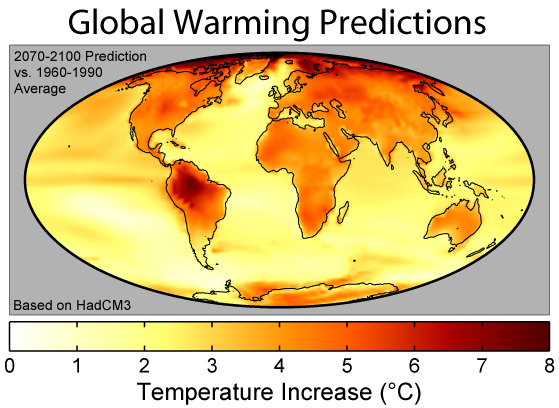
1.Scientists are also studying the Antarctic ice and ice flow in an attempt to determine whether the greenhouse effect, a global warming trend caused by rising levels of atmospheric carbon dioxide, is changing conditions in the Antarctic; examples of such are the thickness of the ice cap and the movement of Antarctic ocean currents, which help cool the Earth. Recent studies indicate that the temperature of Antarctica has increased by 2.5 C degrees (4.5 F degrees) over the last 50 years—a more rapid increase than almost anywhere else on Earth. At the same time, a study (published 2002) of several ice rivers flowing to the coast along the Ross Ice Shelf concluded that they were slowing and thickening. Ice rivers in other parts of western Antarctica were speeding up and sending more ice toward the sea. Thus the contribution of Antarctica to rising world sea levels remains unclear.
Wednesday, September 16, 2009
Subscribe to:
Posts (Atom)